
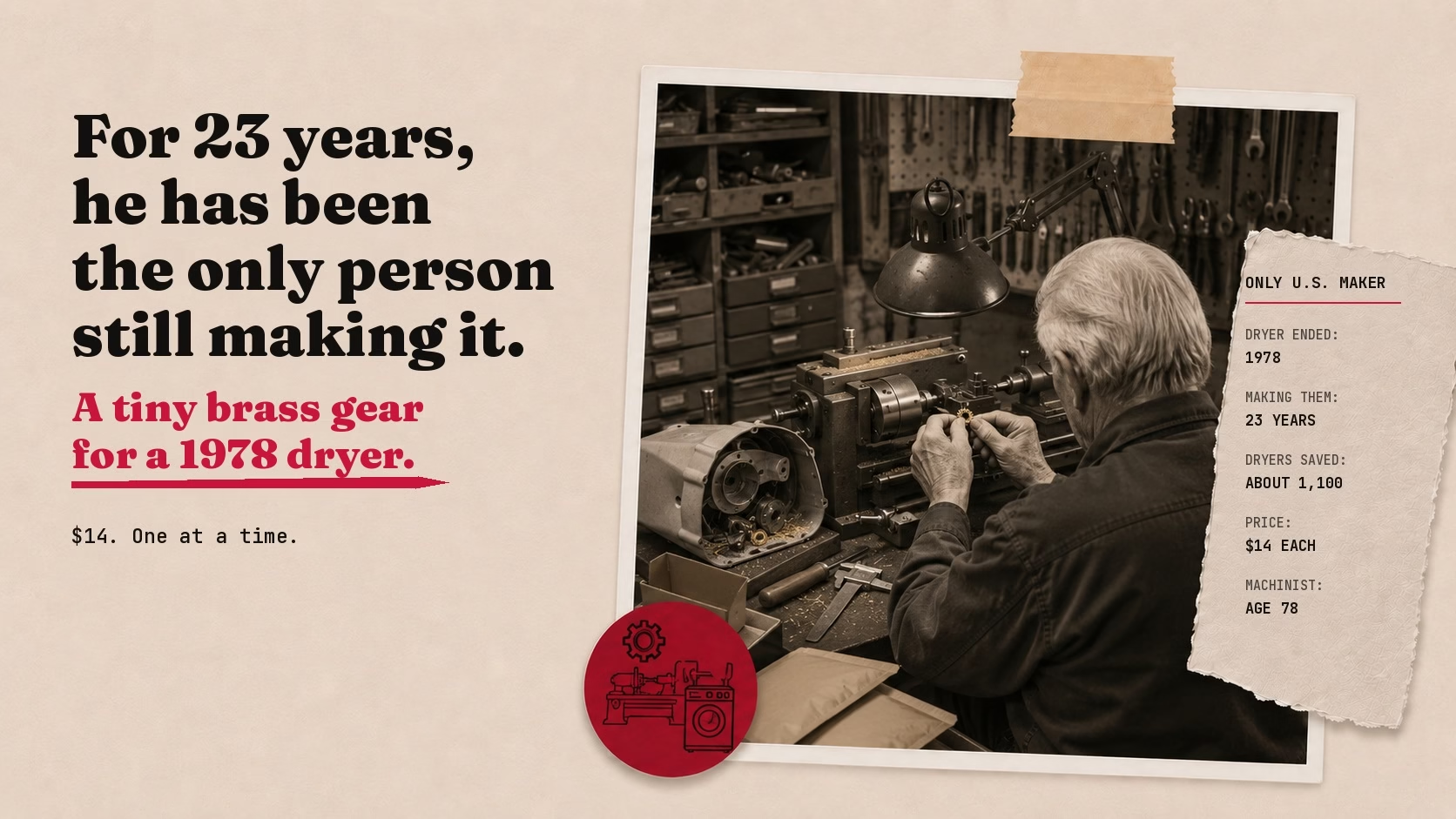
For twenty-three years, he has been the only person in America still making a part for a dryer that stopped being manufactured in 1978.
There is a man in Missoula, Montana who makes a part that no one else in the country makes anymore. It is a brass gear, roughly three-quarters of an inch across, with twenty-four teeth and a square hole in the middle. It drives the mechanical timer of a particular American clothes dryer that was built between 1957 and 1978 and then never built again. He has been making this gear, one at a time, in his garage, for twenty-three years.
He is seventy-eight. I will call him Silas, because he asked me to, and because when I asked why, he said it sounded like the name of a man who has been quietly making a small thing for a long time and does not expect anyone to make a fuss about it. He spent forty-one years as a machinist at a manufacturing plant on the west side of town, retired at fifty-five, and — like most machinists — did not actually stop machining. He simply narrowed his output to a single item.
The gear is the only thing he makes. He makes it because people need it, and because he is, at this point, the only person they can get it from.
The dryer it belongs to
About 840,000 of these dryers were manufactured over their twenty-one-year run. They were built to a standard of mechanical stubbornness that modern appliances do not attempt. Silas estimates that roughly 3,200 of them are still in service in American homes in 2026, a number he tracks the way other men track a stock they own — through vintage-appliance forums, the occasional academic survey of appliance ownership, and direct correspondence with the roughly 1,100 people who have ordered a gear from him over the years.
The number goes down by about eighty a year. At that rate the last of these dryers will die sometime around 2065. Silas does not expect to be present for it, and has made his peace with that.
The gears wear out because they are the one part of the machine doing continuous fine work. After thirty or forty years of engagement the twenty-four teeth round off and stop meshing cleanly with the timer, and the dryer, which is otherwise nearly immortal, quietly stops advancing through its cycle. It is a two-dollar failure in a machine worth keeping. The problem, until Silas, was that the two-dollar part had not existed for sale since 1978.
How it started
The first gear he made was for his mother-in-law.
This was in the fifth week of his retirement, when he was, by his own description, at loose ends — a man who had made things every day for four decades and abruptly did not. He had cycled through the standard retirement candidates (woodworking, gardening, fishing, tutoring) without any of them taking. Then his wife’s mother called from a small town in eastern Washington to report that her dryer, which she had run for thirty-eight years, had died.
Silas drove seven hours to look at it, because he had nothing better to do and because a machinist confronted with a broken machine is not really capable of leaving it alone. Three hours later he had the diagnosis: the timer gear, worn smooth, unavailable anywhere. He told her he could make a new one but would need to take the broken one home to measure it, and could have it back to her in three weeks. She said, “Thank you, Silas,” in the manner of a woman of her generation receiving an offer she had not expected and did not intend to make a scene about.
The first one took four tries before it met his standards. He mailed it. Three days later she called to say the dryer was running. That phone call, he told me, was the moment he understood what the work of his retirement was going to be.
The twenty-three years since
The vintage-appliance world is small and extremely well-connected, bound together by the permanent shared question of where to find a part for something no one sells parts for anymore. Within six months, word had traveled. In late summer of 2003 a handwritten letter arrived from a man in Iowa who had heard, through a mutual acquaintance, that Silas made this particular gear, and would he make one more. Silas wrote back: yes. The man in Iowa was the first stranger. He was followed, over twenty-three years, by about eleven hundred more.
The process has barely changed. Someone with a dead dryer finds him — through a forum, a friend, the website his nephew built in 2011, or an actual letter — and Silas asks them to mail him the broken gear to use as a reference. He turns a new one on his garage lathe over five or six days, then mails it back along with the worn original. He has charged fourteen dollars since 2003 and has never raised the price. It covers the brass and the postage with a little left over. It is emphatically not a business. He is careful to call it a practice.
He could make them in batches. Fifty at a time, an inventory of five hundred, mailed out as orders came. He has declined to, for two reasons. The first is that making a gear for a specific person means spending the week inside that person’s situation — their name, their town, the reason a fifty-year-old dryer is worth the trouble to them. That relationship, he has decided, is the actual point; a shelf of gears made for no one in particular is just a shelf. The second reason is more practical. He is seventy-eight, and he does not expect to outlive a five-hundred-unit inventory. He would rather not leave his wife standing over a box of small brass gears with no idea what they are for.
What the gear actually is
He is clear-eyed about what he is really manufacturing, which is not gears. It is the continued operation of eleven hundred old machines, and behind that, the continued convenience of a very particular kind of person.
These are not people replacing a broken dryer with a new one. They are people who have decided, for their own reasons, that the dryer they have is the dryer they want — because it was their mother’s, or because they bought it the year they married, or because it has simply been in the room for half a century and they are not interested in a relationship with a new one. They do not want the upgrade. They want the specific machine, running. Silas is the man who lets them keep wanting it.
None of this is economically rational, and he knows it. Price his time at any reasonable machinist’s rate and fourteen dollars does not come close. But the value of a retired man’s afternoon is whatever he decides it is, and he has decided this is what he wants to spend his afternoons on. That is the whole calculation.
When he can’t anymore
He has thought about the end of it, and his conclusion is unsentimental: when he can no longer physically make the gears, the practice stops. He has made no arrangements to continue it.
He has considered training a younger machinist, and considered writing out detailed instructions and posting them online, and rejected both. The instructions, he pointed out, would produce a gear that was adequate but not quite right, made by someone without the years in their hands, and he does not want to be responsible for a slightly-worse version of the thing outliving him. He would rather it simply end. When he’s done, the eleven hundred dryers are on their own, and their owners will have to decide whether to keep fighting for them or finally buy something new. That decision, he said, is not his to make. His responsibility ends where his ability does.
Until then, he continues.
The morning before we last spoke, a letter had come from a woman in central Ohio whose dryer — inherited from her mother in 1994 — had stopped mid-cycle the previous week. She wanted to know if he could make her a gear. He had already written back to say yes. Her broken one would arrive within the week; he would spend the following week at the lathe; the new gear would go back to her, with the old one, five days after that. Fourteen dollars.
I have been thinking, since, about the quiet infrastructure of obsolete things — how much of the past that is still running is running because one specific person, somewhere, has decided not to let it stop. Nobody assigned Silas this. He assigned it to himself in the fifth week of an empty retirement and has been at the lathe ever since, keeping eleven hundred machines alive for eleven hundred people he will mostly never meet, for a price that doesn’t cover his time, for reasons that are entirely his own. (For a related piece on people who quietly keep obsolete systems running, see the Wattalife story about the seven employees at a small Nebraska water plant who have spent twenty-nine years writing thirty-two-page letters to whoever will replace them.)
—
Margot Hale is the editor of Wattalife. Since reporting this, she has been wondering how many things she assumes are simply gone are in fact being kept alive, one at a time, by somebody in a garage.