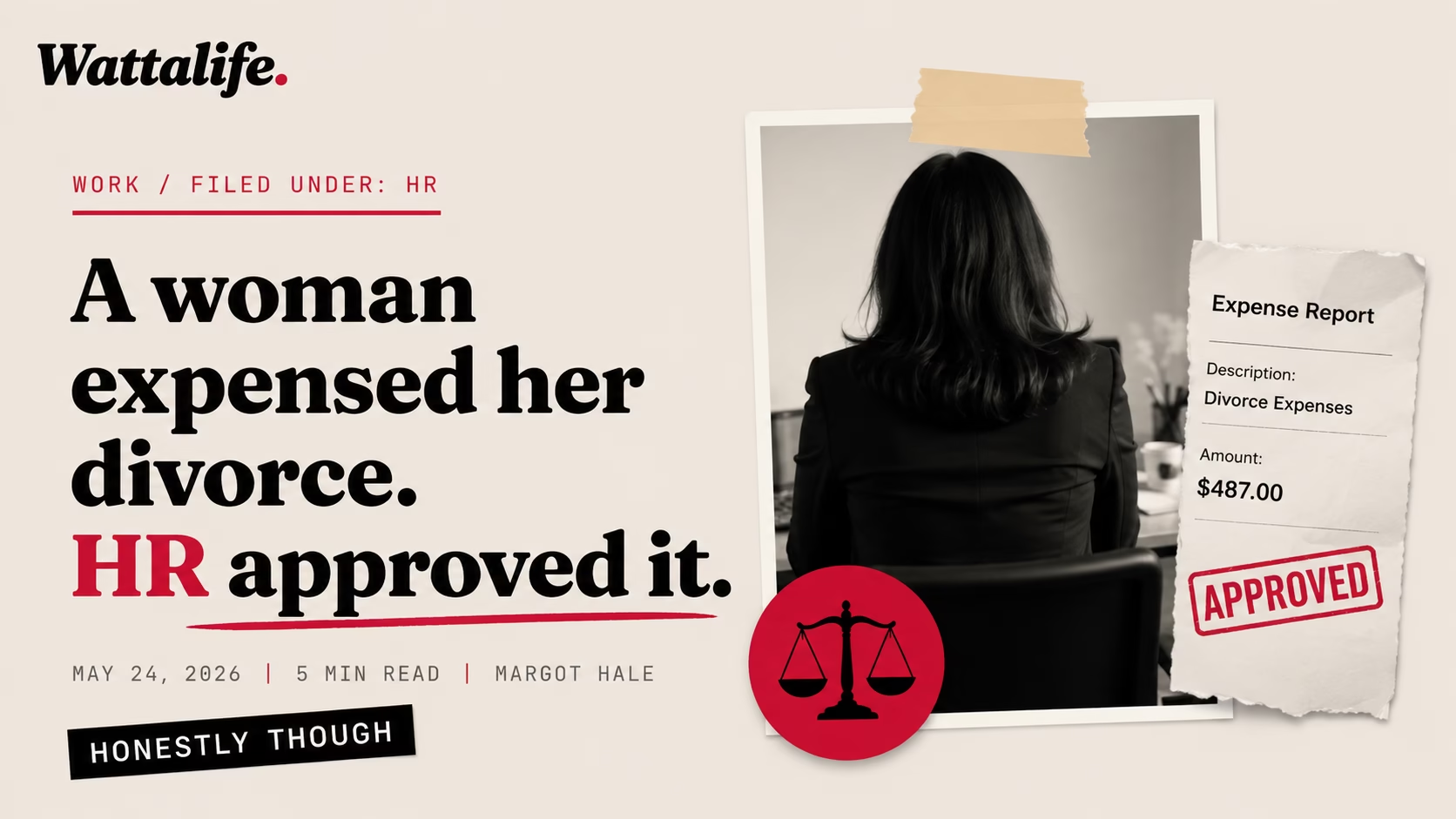
Her employer accidentally paid her twice for six months. She has not told them.
This is a story about a woman who has, for the past six months, been receiving her salary from a Minneapolis marketing firm twice — once through her employer’s primary payroll system and once through what appears to be a secondary payroll system that was never, in any official sense, deactivated — and about what she has done, and not done, in the six months since she noticed.
The woman — I will call her Josephine, because she chose the name, and because when I asked her why, she said, “It sounded like the name of a person who was going to be very careful about how she handled something specific, which I am currently trying very hard to be” — is thirty-four. She works as a senior copywriter at a mid-sized marketing agency in downtown Minneapolis. She started at the agency in the first week of December 2025. She had, in her previous job, been working at a smaller agency in the same city. She had moved for what she considered, at the time, a genuinely good reason: her salary at the new agency was approximately eighteen thousand dollars a year higher than it had been at the old one.
She has, since the second week of December 2025, been receiving that salary twice.
The first time she noticed
Josephine noticed the second paycheck, in her account, exactly one week into her new job.
She had, on her second Friday at the new agency, received her first paycheck. The paycheck was, in the amount, exactly what she had been expecting. It was direct-deposited into her checking account. It appeared, according to her banking app, at approximately 3:47 a.m. on Friday morning.
The second deposit appeared, in her banking app, at approximately 9:22 a.m. that same Friday.
The second deposit was, to the exact dollar, the same amount as the first.
Josephine, when she noticed the second deposit, was at her desk at work. She had opened her banking app on her phone, casually, to confirm that her first paycheck had arrived — a routine she had been doing every payday for approximately eleven years. She had seen the first deposit. She had, out of curiosity, scrolled down.
She had seen the second one.
She has told me she stared at her phone for what she estimated was approximately forty-five seconds.
She has told me she then, in her own words, “did something I have thought a great deal about since.” She refreshed the app. She wanted to make sure the second deposit was not a display error. It was not. She screenshotted the transaction history. She locked her phone. She put it in her desk drawer.
She has told me she then spent the rest of the day, in her own account, “trying to work normally, which turned out to be more difficult than I would have expected.”
What she did that weekend
Josephine spent that weekend, by her own account, thinking.
She has told me she considered, over the course of the weekend, three possible explanations for the second deposit.
The first was that it was a mistake she should immediately report. She should, on Monday morning, walk into her HR representative’s office and tell them what had happened.
The second was that it was some kind of signing bonus or double-first-paycheck arrangement she had not been told about. This seemed, by her account, “unlikely, but possible.”
The third was that it was a payroll error that would, without her intervention, correct itself. That the payroll system had, in the first week of onboarding, generated a redundant payment that would not repeat.
She has told me she decided, over the course of that weekend, that the third explanation was the most likely one. Payroll systems, she has told me, are known to be strange during onboarding. She has told me she had, in her previous jobs, seen small clerical errors that corrected themselves within a pay cycle or two.
She has told me she decided, over the course of that weekend, to wait one more pay period before saying anything.
The second pay period
The second pay period arrived two weeks later.
Josephine received her first paycheck at 3:51 a.m. on a Friday morning.
She received her second paycheck at 9:19 a.m. on the same Friday morning.
The amount, both times, was correct.
Josephine, in her account, spent the entire following weekend thinking again.
She has told me she considered, this time, four possible explanations.
The first was still that she should report it.
The second was that some administrative record somewhere — possibly connected to a shared payroll vendor between her previous agency and her new agency — had failed to close properly when she left her old job. That her previous agency, in some way she did not understand, was continuing to pay her. She has told me she checked the deposits carefully. Both deposits, however, appeared in her app under the name of her current employer. Neither of them was, in the visible metadata, from her previous employer.
The third was that her current employer had, in some way she did not understand, set her up on two separate payroll systems and had been running her through both of them. She has told me this seemed, based on her professional experience, “improbable but not impossible.”
The fourth was that the situation was, in some way she could not identify, being tested. That HR or IT was watching to see whether she would report the second deposit. That the second deposit was, in some sense, a test of her professional integrity.
She has told me she decided, over the course of that weekend, that the fourth explanation was unlikely but not impossible. She has told me she also decided, over the course of that weekend, that regardless of the correct explanation, she was going to give it another pay cycle.
She has told me: “I told myself I was gathering information. I told myself I was going to make a decision when I had more data. In retrospect, I think I was telling myself something I wanted to believe.”
The system she developed
Over the six months that followed, Josephine has developed a specific and careful system for handling the second paycheck.
She has, in each pay period, taken the following actions.
She has confirmed that the first paycheck arrived in the correct amount. She has confirmed that the second paycheck arrived in the correct amount. She has taken a screenshot of both deposits. She has saved the screenshot in a folder on her phone.
She has then transferred the entire amount of the second paycheck out of her primary checking account and into a separate high-yield savings account she opened, in her own name, at a different bank than the one her primary checking is with. The transfer, she has told me, takes place at exactly 8 p.m. on the evening of each payday. It has taken place, without exception, thirteen times.
She has spent none of the money in the savings account.
She has, at the time of this writing, accumulated approximately fifty-one thousand dollars.
The savings account earns approximately five percent interest.
Josephine has told me she checks the balance of the savings account, on average, once every two weeks. She has told me the check is brief. She looks at the balance. She notes it. She closes the app.
She has told me she has not, in six months, taken any action with the money beyond the initial transfer.
What she has told her partner
Josephine lives with a partner — I will call him Andrew — who I have not spoken with, but who Josephine has spoken about at some length. Andrew is a physical therapist. They have been together for four years. They share a small apartment in the Uptown neighborhood of Minneapolis. They have, according to Josephine, a joint account for household expenses and two separate accounts for personal expenses.
Josephine has not told Andrew about the second paycheck.
I asked her, in our first phone conversation, why not.
She has told me, first, that she does not want to worry him. She has told me she believes Andrew, if he knew about the second paycheck, would immediately want her to report it. She has told me she believes Andrew is, in her phrasing, “an unusually good person, and this is one of the things I love about him, and it is also one of the things that makes it hard to tell him certain things.”
She has told me, second, that she does not want to be told what to do. She has told me she is, in the six months since the deposits began, “in the process of figuring something out that I want to figure out myself. If I tell Andrew, it stops being mine. It becomes ours. I am not, yet, ready for that.”
She has told me, third, that she is not sure the money is going to remain accumulating for much longer, and she does not want to introduce a fact into her relationship that may, at any moment, disappear.
She has told me she has, in the past two months, considered telling him several times.
She has told me she has not, so far, done so.
Why she has not reported it
I have asked Josephine, in the course of three phone conversations, why she has not reported the double paycheck to her employer.
She has given me a great deal to work with. I will attempt to summarize.
The first reason she has given me is that reporting it, at this point, would be complicated. Six months of double paychecks amounts, in her account, to approximately fifty-one thousand dollars. If she reports the error, her employer will presumably want the money back. The money is, technically, sitting in her savings account. She can, if asked, return it. But she has told me she is not certain what the paperwork of returning it would look like. She has told me she is not certain whether returning it would come with any professional consequences — a reprimand, a note in her HR file, a change in her supervisor’s regard for her. She has told me the risk of consequences, six months in, feels higher than it did six weeks in.
The second reason she has given me is that she is genuinely uncertain, at this point, whose fault the situation is. She has told me: “The error was made by their payroll department. It has been sustained by their payroll department. It has been reviewed, presumably, by their HR department, and by whoever runs their monthly reconciliations, and by whoever runs their quarterly audits, over the course of six months. Nobody, over the course of six months, has caught it. I am not the only person responsible for finding it. I am not, technically, responsible at all. I am the person who is receiving the money. I did not create the situation. I have not, in any way, encouraged the situation.”
The third reason she has given me is that she has been, in the six months since the situation began, undergoing what she has described to me as “a slow revision of my views on the arrangement between me and my employer.”
She has told me: “I have worked at four companies in my professional life. I have, at each of them, been paid less than I was worth. I have, at each of them, been asked to do more work than I was hired for. I have, at each of them, been passed over for a promotion at least once for reasons that had nothing to do with my performance. I have, at each of them, seen colleagues be laid off with two weeks of notice because the company needed to hit a quarterly target.”
She has told me: “I do not believe my employer is, in any moral sense, my friend. I do not believe my employer, if they knew that I had underpaid myself by fifty-one thousand dollars over six months, would rush to correct the error in my favor. I believe they would keep the fifty-one thousand dollars. I believe they would consider it my responsibility to have caught the mistake.”
She has told me: “I am, in the six months since this began, holding a piece of asymmetric information. I did not create the asymmetry. The asymmetry was created by my employer’s payroll department. I am, in the meantime, being extremely careful with the money. I am not spending it. I am not gambling with it. I am holding it in an account I can access on twenty-four hours’ notice, if the error is caught, and return in its entirety.”
She has told me: “That, I think, is more than my employer has ever done for me.”
What she has decided
I have asked Josephine, in each of our three conversations, what she plans to do.
She has told me she does not, precisely, know.
She has told me she has, in the past two months, arrived at what she has called “a small careful plan.” The plan is: she will continue to accept the second paycheck until either the error is caught or she has accumulated one hundred thousand dollars. Whichever comes first. At that point, she has told me, she will take one of two actions.
If the error is caught first, she will return the entire accumulated balance without argument. She will accept any consequences that come with it. She will, in the process, be able to say — truthfully — that she never spent a dollar of the money, that she never invested it in anything speculative, that she never treated it as her own.
If she reaches one hundred thousand dollars first, she has told me, she will report the error herself. She will explain, honestly, that she noticed the second paycheck early on. She will explain that she was, in her own account, “uncertain how to handle it, and made a small careful decision to hold the money in trust while I figured out the right response.” She will offer to return the entire accumulated balance. She has told me she believes, with some but not complete confidence, that her employer would be, in that circumstance, “either grateful for the honesty or furious about the six months of delay. I do not know which. I am not sure they know which. I am not sure the answer is stable.”
She has told me the amount — one hundred thousand dollars — was chosen deliberately. She has told me one hundred thousand dollars is, in her personal accounting, the amount of money that would fundamentally change something. Not a small buffer. Not a savings supplement. A number that, if kept, could plausibly buy her something — a down payment, a career break, a year of not working — that would meaningfully change her life.
She has told me she is not going to keep the money.
She has told me she is, however, going to see what it feels like to be one signed form away from keeping it.
She has told me she has already learned, in the past six months, several things about herself.
She has told me the most significant thing is: “I am the kind of person who can, apparently, sit with an ethically ambiguous piece of information for six months without acting on it. I did not know this about myself. I would have said, before this happened, that I was the kind of person who would have reported it in the first week. I have since learned I am not that kind of person. I am somewhere else on the spectrum. I have not yet located exactly where.”
What this is
I have, in the weeks since I first heard this story, thought about the specific quiet ethical situations that modern administrative life creates for individual people. Josephine did not seek out this situation. She did not, in any way, engineer it. The situation was created by an administrative error made by a payroll department she does not, in her own account, have any real relationship with. The situation has been sustained, over six months, by that same administrative department’s failure to notice a discrepancy that should, by any reasonable audit, have been visible.
Josephine has, in the meantime, been holding the money. She has, in the meantime, been thinking about who she is, and what she owes to her employer, and what her employer owes to her. She has, in the meantime, been arriving at a specific and — I would argue — somewhat uncomfortable set of conclusions about the actual terms of the arrangement between her and the company she works for.
I do not know exactly what to make of her decision. I do not think it is, in the strict sense, correct. I do not think it is, in the strict sense, incorrect. I think it is, in the specific way of the modern administrative age, honest — honest about the actual imbalance of information and care between an individual employee and a corporate payroll system. (For a related earlier piece on the small quiet decisions people make about money that they do not, in the moment, know how to justify, see the Wattalife story about the woman in Atlanta who has been anonymously paying off her ex-boyfriend’s student loans for three years.)
Josephine told me, in our final conversation, that she has been thinking, lately, about whether she is, in some way, becoming a different person than the person who took this job in December.
She has told me she is not sure.
She has told me: “I think the person who took the job in December would not have kept the money for six months. I think the person I have become, in the six months since, would keep it for a little while longer. I do not know if the change is good or bad. I do not know if the change is temporary. I know only that it has happened.”
She has told me she checked the savings account balance the night before we last spoke.
She has told me it was fifty-one thousand, seven hundred and forty-two dollars.
She has told me: “I have about forty-eight more thousand dollars to go, one way or the other.”
—
Margot Hale is the editor of Wattalife. She has, since reporting this story, briefly gone through her own recent bank statements to confirm that she has not been, inadvertently, receiving anyone else’s money. She has not. She has, however, in the process, noticed several small charges she does not entirely remember making. She has decided, for now, not to look into them. She would rather, at this point, not know.