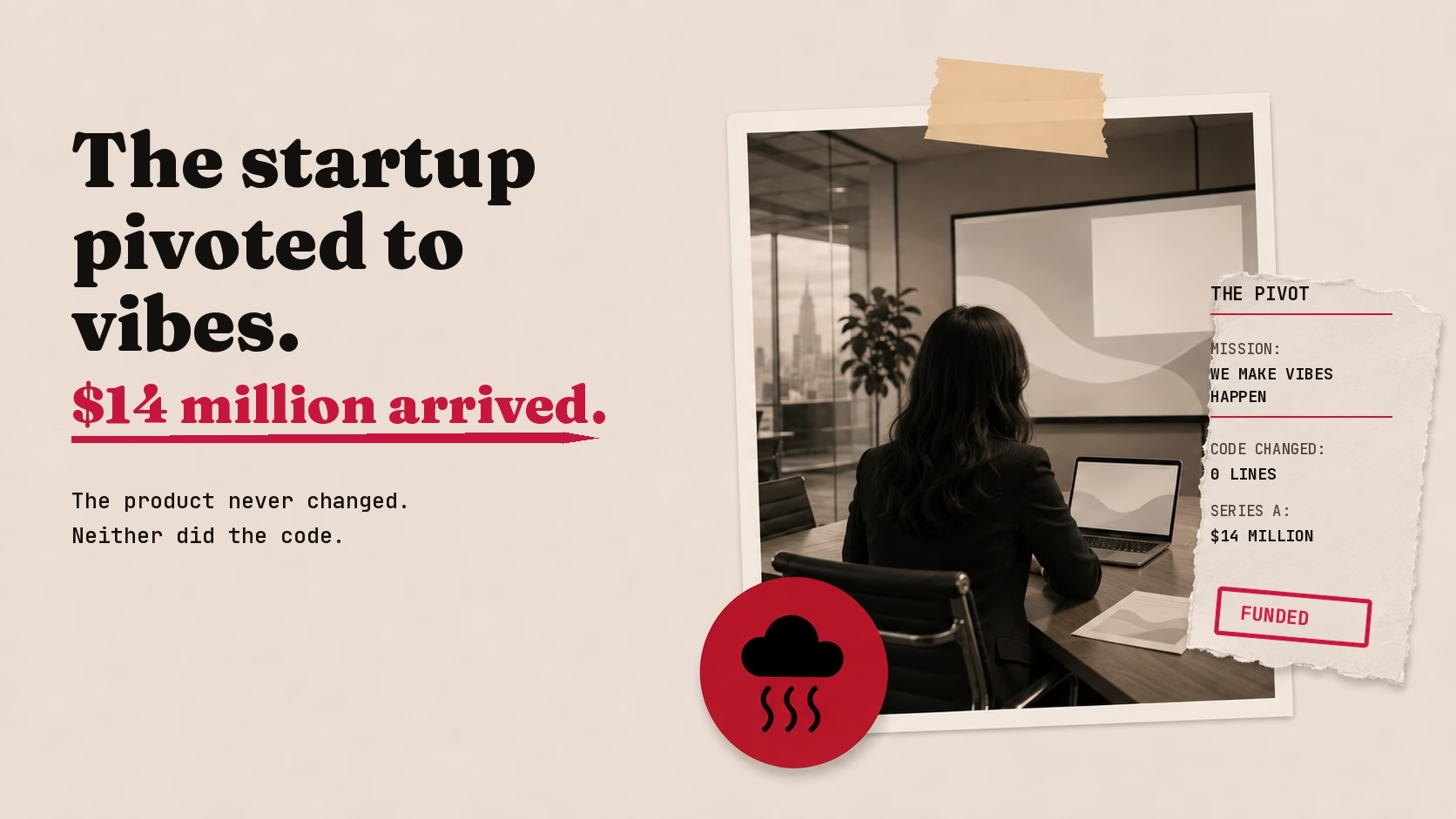
The startup pivoted to vibes. The Series A came through anyway.
The pivot happened on a Tuesday.
The company — I will call it Nimbus, because the founders have asked for anonymity and because the actual name is somehow worse — had spent eighteen months building what their pitch deck called “an end-to-end AI orchestration layer for mid-market knowledge workflows.” Nobody, including the founders, was entirely sure what this meant. The product, according to the three customers they had managed to acquire, did things. It connected to things. It produced outputs. The outputs were, in the words of the senior product manager who eventually quit, “technically correct and somehow emotionally wrong.”
On the Tuesday in question, the CEO — a 34-year-old former management consultant named Mira — opened a Notion doc, deleted the mission statement, and typed, in its place:
“We make vibes happen.”
She showed it to her co-founder. Her co-founder said, “What does that mean.”
Mira said, “I don’t know yet. But it’s true.”
The pivot
By Friday of that same week, the homepage had been rewritten. The hero text, which had previously read “Intelligent Process Automation for the Modern Enterprise,” now read “Software that feels like the right thing to do.”
The product had not changed. The code had not changed. The customers had not changed. What had changed was the description of what the product was for.
This is not, I am told by people who follow these things, an unusual move in 2026. The technology industry has produced, in the last three years, approximately four hundred companies whose function is genuinely difficult to articulate, and a corresponding number of pitch decks whose language has drifted further and further from any object you can point at in the world. Somewhere in the gap between “we orchestrate intelligent workflows” and “we make vibes happen” sits the question every founder is quietly trying to answer: what if we just told the truth.
Mira told the truth.
The investors
The Series A round closed on a Thursday in March. The lead investor was a fund I will not name, run by a man I will also not name, who is generally considered to be one of the more thoughtful capital allocators of his generation. He sat on the pitch for forty minutes. He asked seven questions. None of the questions were about the new mission statement.
In his post-meeting notes, which I have not seen but which I have heard described twice, he wrote: “Strong team. Compelling traction. Path to $100M ARR by 2028 if they execute. Mission statement could use sharpening.” He invested $8 million.
The second investor — a Boston-based growth fund — invested $4 million and, in their formal investment memo, referred to the company as “a leader in the intelligent workflow automation space.” The memo was sent on a Wednesday. The new mission statement had been live on the website for six weeks at that point.
The third investor invested $2 million and specifically cited the vibes pivot in her decision. Her name is Carmen, she is 51, she ran two companies in the 1990s, and she has been described to me, by several different people, as “the only person in the room who is paying attention.” Carmen told Mira, on a Zoom call the morning after the term sheet was signed: “I have been in this industry for thirty years. You are the first person who has ever told me what your company does.”
Mira said: “Thank you.”
Carmen said: “I didn’t say it was good.”
The case study
A Stanford Graduate School of Business case study about Nimbus is, as of this writing, in development. The professor leading the study has interviewed Mira, the co-founder, two of the early employees, and one of the investors. The case study’s working title, according to a draft I was forwarded, is “Linguistic Honesty as Competitive Advantage in B2B SaaS.”
The case study runs to forty-three pages. It contains seventeen graphs. It cites Wittgenstein on page nine.
Nobody at Nimbus has read it. Mira has been told it exists. She has said, on at least two occasions, that she does not want to read it. “If I read it,” she told me last week, over a coffee at a café in the Mission, “I will start performing it. And then the vibe will be gone.”
What the vibe was
I asked Mira, several times, over the course of three separate conversations, what the actual vibe of the product was. What did the software do that made people feel a certain way. What was the feeling.
She answered the same way every time.
“It loads fast,” she said. “It looks like it was designed by someone who slept. The buttons go where you think they should go. When you click them, the thing happens. When the thing fails, the error message is in English. The pricing page has a price on it. There is no AI assistant in the bottom-right corner asking if you need help.”
I said: “That’s the vibe?”
She said: “That’s the entire vibe.”
The Series B is reportedly being raised on a flat round at a $200 million valuation.
I am not making this up. The Stanford case study is real. The seventeen graphs are real. The investor memo that referred to the company as “a leader in the intelligent workflow automation space” six weeks after the vibes pivot is, I have been assured by a person who has seen it, also real.
But Wattalife, as you may have noticed at the bottom of this page, is satire. Which means I have changed the names, softened the details, and invented at least three things that did not happen.
I will let you decide which three.
—
Margot Hale is the editor of Wattalife. She has, in the course of reporting this story, encountered at least two other startups whose mission statements have, in the last quarter, drifted in a similar direction. She is keeping a list.