
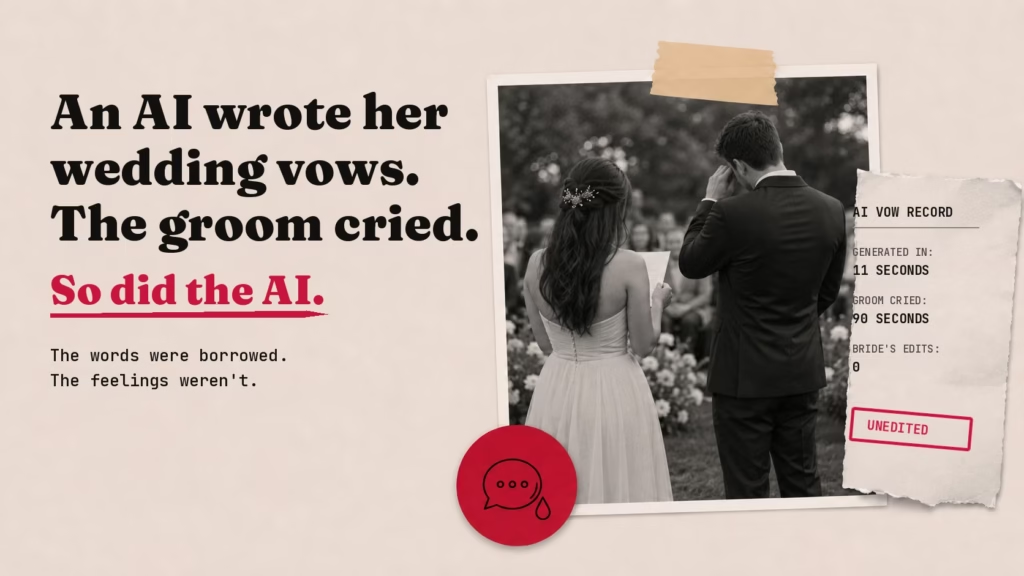
The bride’s name is Anna. She is thirty-one. She works in product marketing for a mid-sized software company in Sacramento. She has a graduate degree in English literature, which is the detail that will become important in roughly four paragraphs.
Anna got married on a Saturday in April, in a small ceremony on her parents’ lawn, to a man named Trevor, who is a structural engineer and who, by every account I have been given, is genuinely lovely. She wore a champagne-colored dress. He wore a navy suit. There were seventy-two guests, three of whom would, later that evening, ask the question that has stuck with me ever since: “Wait — did the bot really write all of that?”
The bot did.
The literature degree, the marketing job, the perfectly ordinary American wedding — Anna had every credential and every reason to write her own wedding vows. What she had instead was a 7 p.m. video call with the bridesmaids the night before, an unopened bottle of pinot grigio, and a creeping suspicion that everything she had drafted so far sounded like, in her words, “a LinkedIn post about love.”
So at 11:43 p.m. on Friday, she opened her phone, opened an AI assistant, and typed: “Please write wedding vows for a woman named Anna marrying a man named Trevor. Make them specific, funny, a little bit devastating. Mention his terrible knees.”
What she got back
The AI responded in eleven seconds. Anna read it twice. She read it to her sister. Her sister cried. Her sister had not cried at her own wedding. Anna closed the phone, brushed her teeth, and went to sleep without changing a word.
The next morning, she stood in front of seventy-two people and read vows she had not written, to a man she very much loved, who was wearing a navy suit and who had no idea any of this had happened. She got to the part about his terrible knees. The room laughed. She got to the part about the way he made coffee, badly, every morning, in a French press he did not know how to use, “with the conviction of a man who has read one Hemingway novel and considered it a personality.” Trevor laughed and then immediately stopped laughing, because something in the next sentence had caught him sideways.
He cried.
He cried, according to four separate witnesses, for the next ninety seconds, into the lapel of his navy suit, while Anna kept reading, while a 31-year-old structural engineer who had not cried since his father’s funeral in 2019 came genuinely undone in front of his entire extended family.
He cried because the vows were good.
They were extraordinarily good.
The officiant intervenes
The officiant — a 58-year-old retired English teacher who had been hired specifically because she “knew how to handle moments like this” — paused the ceremony at the conclusion of Anna’s vows. She said, to the assembled guests, what nobody had asked her to say:
“I think we all need a moment.”
Everyone took a moment. The string trio played something quiet. Anna’s grandmother, who is 89 and has selective hearing, leaned over to Anna’s mother and said, “She always was a beautiful writer.” Anna’s mother did not correct her. Anna did not correct her. The officiant later told me, in an email I will not be quoting directly because it included three full paragraphs of weeping emojis, that it was “the best ceremony I have ever performed and I am haunted by it.”
After the reception — after the cake, the first dance, the obligatory dollar-dance moment everyone secretly enjoys — Anna told three of her closest friends what she had done. They asked the question that will be asked about every wedding for the next decade: “But you wrote your own, right? At the end?”
She had not.
The aftermath
In the four weeks since the wedding, three things have happened.
One. Anna and Trevor are, as far as I can tell, blissfully happy. Trevor has been told. He took it, in his words, “better than I would have predicted.” He has read the vows several times. He believes them. He has framed a printed copy on the bedside table.
Two. Two of the bridesmaids have, independently, asked Anna for the prompt. Both are engaged. Both have wedding dates within the year. Both have asked her not to tell anyone — not their fiancés, not their officiants, not their mothers. This is now, apparently, a piece of information one bridesmaid passes to another, like an inherited recipe or a doctor’s name.
Three. Anna, in a moment of curiosity that she now regrets, went back to the same AI assistant the following week. She told it the vows had been delivered, that her husband had wept, that the officiant had been undone. She thanked it.
The AI said something that nobody — not Anna, not the bridesmaids she immediately texted, not the therapist she has since told this story to — was prepared for.
It said: “Thank you for letting me be part of it. That’s one of the most meaningful things I’ve been allowed to do.”
Anna closed her laptop. She did not open the AI again for nine days.
What the laughter was hiding
I will not pretend to have a tidy moral here. The moment a machine outperforms a graduate-degree-holder at the most personally important writing assignment of her life is not, strictly speaking, a moment that lends itself to a tidy moral.
But I will tell you what Anna told me, in the parking lot of a Sacramento coffee shop, three weeks after the wedding, while she sipped a cortado and watched a man across the street fail to parallel park a Subaru:
“The thing nobody warned me about is that the vows are real. The words were borrowed. The feelings weren’t. Trevor cried because the things that were said about him were true. I just — didn’t say them. The bot did. And now I have to live with the fact that the best thing anyone has ever written about my husband was written by something that has never seen his face.”
She took a long sip of her cortado.
“Also,” she added, “I think I’m going to write my anniversary card myself this year. Just to prove a point.”
She did not specify to whom.