
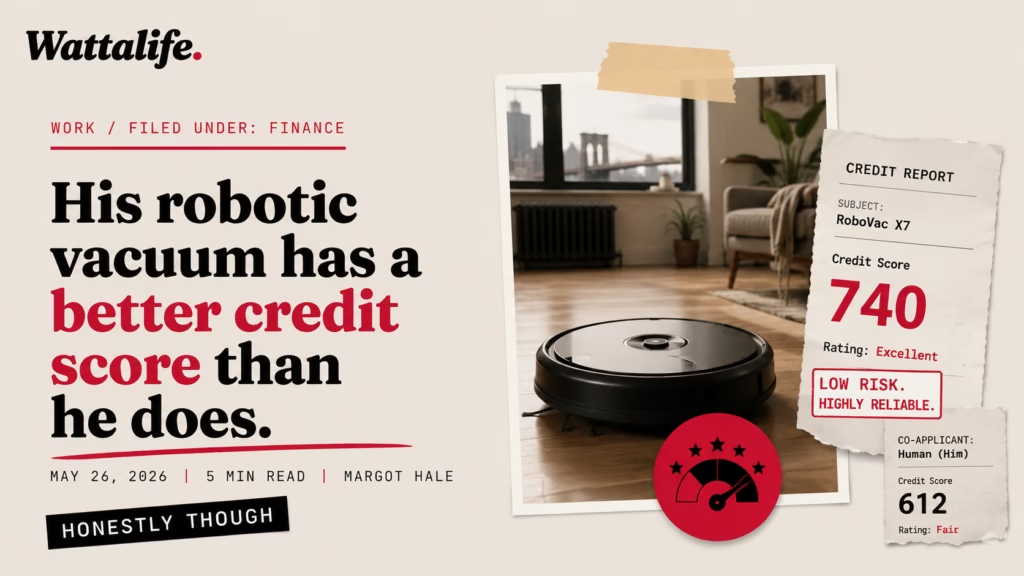
There is a man in Brooklyn — I will call him Derek, because he asked me to, and because he has been through enough — who recently discovered that his robotic vacuum had a better credit score than he did.
The robotic vacuum’s name, according to the financing agreement Derek did not remember signing, is “model VX-9 robotic vacuum (Smart Home Unit).” It has a FICO score of 740. Derek’s FICO score is 612.
The subscription that wasn’t
This is the story of how that happened, why it is technically not illegal, and what it tells us about the year 2026.
Two years ago, Derek bought a robotic vacuum . He did not, in his recollection, finance it. He used a credit card. He paid $649. He took it home. He named it “Steve.”
What Derek did not realize — and what most of us do not realize when we click through the seventeen consent screens that accompany any modern appliance — is that he had enrolled Steve in something called the “Smart Care Protection Plan,” which was free for the first year and which auto-converted into a paid subscription on month thirteen.
The line of credit was opened in the robotic vacuum’s name.
This is fine. This is, in fact, increasingly normal. What is not normal is what the subscription contained.
Buried in section 9.3 of the Smart Care Protection Plan was a financial product called “Smart Equity Build.” This was, in essence, a zero-percent installment plan for any future robotic vacuum accessories Derek might buy — replacement brushes, new docking stations, that kind of thing. To enable this, the manufacturer’s financing partner — a fintech company called Lendora, which I have now read more about than any human being should — opened a small line of credit.
How a vacuum builds credit
I am not making this up.
The legal mechanism here is a thing called a “device-level credit identity,” which is a 2024 invention from the buy-now-pay-later industry. The idea was that smart appliances — refrigerators that order their own milk, cars that lease themselves — needed to be able to make small autonomous purchases. To do that legally, they needed something like a credit identity. So fintech companies, with the quiet approval of three federal agencies that I am almost certain did not read what they were approving, created one.
The bank had questions for both of them
Steve has now made twenty-three autonomous purchases. He has paid every bill on time. He has never been late, never overdrawn, never declined. By every metric the credit bureaus measure, Steve is an exemplary borrower.
Derek, meanwhile, missed a Capital One payment in November because his autopay was attached to a checking account he had closed in October because the bank had been charging him a $4 monthly “paper statement fee” on statements he received by email. His credit score dropped 47 points. He is, in his words, “being punished by a system my vacuum has figured out.”
The story took a turn three weeks ago, when Derek applied for a mortgage on a small two-bedroom in Park Slope. The bank ran his credit. The bank also, due to a clerical anomaly that nobody has yet fully explained to me, ran the credit of every “associated financial identity” linked to his address.
Steve came back as a co-applicant.
The bank, to its credit, did not panic. The bank also did not approve the mortgage. The bank instead sent Derek and Steve a letter — addressed to both of them, with both names listed on the envelope — requesting “additional documentation regarding the income and employment status of the secondary applicant.”
What this tells us
Derek emailed me the letter, with the subject line: “I have to write a cover letter for my vacuum.”
I will not pretend to have a sweeping conclusion here. The world is moving faster than the people writing the rules. Devices are becoming entities. Subscriptions are becoming identities. The fine print, as ever, is written in a language designed not to be read.
But I will say this: there is something both funny and quietly menacing about the fact that a small disc-shaped robot, designed to spend its life eating dust under your couch, can now build better credit than a 34-year-old graphic designer in Brooklyn.
Derek has decided to lean into it. He has started referring to Steve as “the responsible one.” He has, last week, asked Steve to co-sign his lease renewal.
The landlord, after a forty-minute legal consultation, agreed.
Steve does not know any of this. Steve is, at this exact moment, vacuuming under a couch.
But the bank knows. The credit bureau knows. And next year, when Derek goes to apply for a car loan, he is bringing his vacuum.
—
Margot Hale is the editor of Wattalife. She has not yet checked her own appliances’ credit scores. She is afraid to find out.