
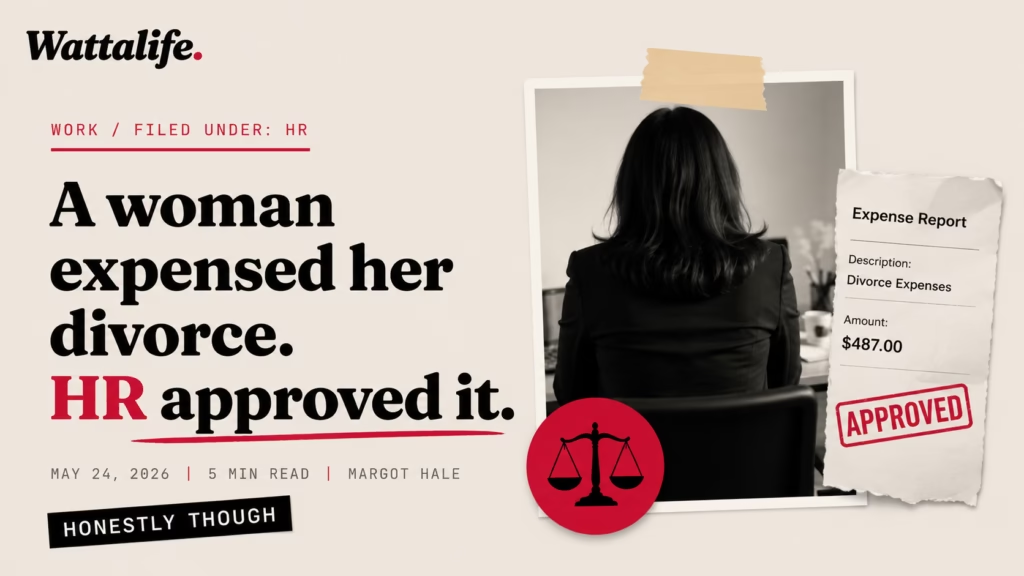
The email arrived in HR’s inbox on a Tuesday in March, time-stamped 9:47 a.m. It contained a $487 receipt from a family law attorney in Denver, a brief subject line — “reimbursement: marital dissolution consultation” — and the kind of confidence usually reserved for people submitting an Uber to the airport.
The HR rep, who has asked not to be named because she still works there and would like to continue working there, told me she stared at the screen for a full minute before doing anything. Then she did the thing that, in retrospect, has changed the course of her workplace’s expense policy forever.
The reasoning, which is somehow worse than the act itself
She approved it.
Here is the part that I cannot stop thinking about. The employee — a 34-year-old senior account manager I’ll call Lena, because she asked me to — did not sneak the expense through. She did not bury it in a stack of legitimate charges. She did not, as one Reddit commenter would later suggest, “code it as a working lunch.”
She submitted it like a normal receipt. With a note.
The note, according to a screenshot Lena shared with me, read:
“Per the Employee Handbook section 7.3, the company covers ‘reasonable expenses related to relocation, including legal consultation, when the move is required for continued employment.’ My ex-husband is relocating to Phoenix for his job. I am not. Please reimburse.”
She had, in other words, found a loophole written by lawyers, and used it for a divorce filed against a man who once forgot her birthday three years in a row.
The HR rep read the note twice. She read the handbook. She emailed her manager. Her manager emailed Legal. Legal emailed the CFO. The CFO, according to two people on that thread, replied with one word.
What this tells us about the modern American workplace
“Pay it.”
The handbook in question was written in 2019 by an employment law firm that charges $850 an hour and apparently does not believe in editing. It was designed to cover the relocation expenses of executives moving across state lines. It did not anticipate that one day, a woman in a cubicle in the Denver office would notice that the words “required for continued employment” could be reasonably interpreted to mean “required because the alternative is being legally tied to a man in Phoenix who is, quote, ‘incompatible with my long-term goals.'”
She is not wrong. That is the most haunting part. She is not wrong.
The handbook does not specify whose relocation. The handbook does not specify the marital status of the parties involved. The handbook, like most corporate handbooks, was written under the assumption that everyone reading it would be too tired or too obedient to read it carefully.
Lena was neither.
The aftermath, which is its own art form
In the six weeks since the reimbursement cleared, three things have happened:
One. The HR department has hired a consultant to rewrite the relocation clause. The consultant charges $675 an hour. He has not yet finished.
Two. Two other employees have submitted “exploratory” expense reports — one for couples counseling described as “team building,” another for a deposit on a one-bedroom apartment described as “remote work infrastructure.” Both are currently pending review. Neither has been denied.
Three. Lena was promoted.
I asked her, over a Zoom call from her new apartment, whether she felt any guilt about any of this.
She thought about it for what I would describe as exactly long enough to be polite.
“My ex-husband expensed his fantasy football league to his company in 2019,” she said. “He called it ‘professional networking.’ They paid it. I think we’re even.”
What we are supposed to take from this
I have been writing about modern adult life long enough to know there is rarely a clean lesson. The world does not arrange itself into morals. Most of what happens to us is just things happening, and the only meaning is what we agree to assign to it later, usually in group chats.
But if I had to pick one thing — and I am being asked to, by my editor, who is also me — it would be this:
The systems we live inside are not as solid as they look. The handbooks were not written by careful people. The policies were not stress-tested. The fine print was not, in fact, designed to be read. It was designed to be skimmed past on the way to clicking Accept.
Lena read the fine print.
And then she did the thing the fine print, technically, said she could do.
She is, depending on your point of view, either the bravest woman in Denver or the most expensive divorce attorney in the country.
I am, depending on my mood, slightly afraid of her.
—
Margot Hale is the editor of Wattalife. She has read your employee handbook. You have not.