
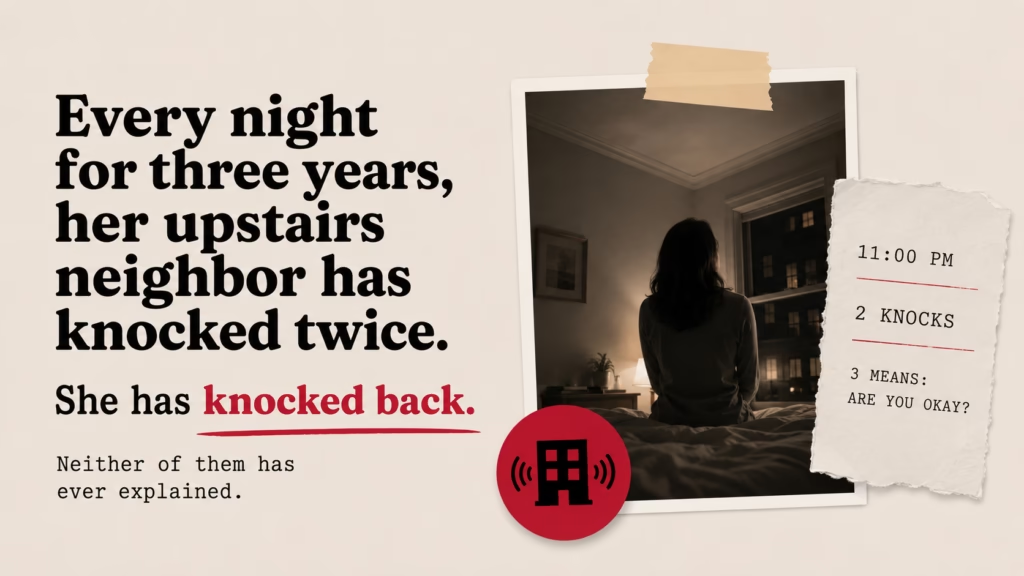
This is a story about a woman who has lived, for the past six years, in the specific second-floor apartment of a small four-unit brick building in the Northside neighborhood of Cincinnati, the specific person who has lived in the third-floor apartment directly above her for the past four of those years, and the specific arrangement — if the specific word “arrangement” is even the specific correct word for what it is — that the two of them have quietly sustained across the ceiling that separates their two apartments for the past three years.
The woman — I will call her Odile, because she chose the name, and because when I asked her why, she said, “It is the name of a person who is not sure what she is doing, which I have decided, over three years, is what I am,” which I found accurate — is forty-eight. She works as a hospital-based occupational therapist. She has been divorced since 2016. She has no children. She has lived, since 2020, in the small one-bedroom apartment where the specific arrangement this story is about occurs.
The person who lives directly above her — she does not know his name — she will call, for the purposes of this article, “the person upstairs.” She has, in the specific way of certain kinds of apartment dwellers in certain kinds of buildings, never actually met him.
She knows, in her own careful account, the following about him.
She knows he is, based on the specific weight of his footsteps and the specific rhythms of his daily movements, a man. She knows he is, based on the specific sound of his voice on the specific rare occasions she has heard him speak on the phone through the floor, in what she estimates to be his early sixties. She knows he lives alone. She knows he goes to bed, on most nights, at approximately 10:30 p.m. She knows he wakes up, on most mornings, at approximately 6:00 a.m. She knows he leaves the apartment on most weekdays at approximately 7:15 a.m. and returns at approximately 5:45 p.m. She knows he does not, in the four years he has lived there, appear to have had any visitors other than one specific person — she believes an adult son, based on the specific rhythms of the visits — who comes over for approximately three hours on the specific first Sunday of every month.
She knows one other thing.
Every night, at approximately 11:00 p.m., he knocks twice on his floor — which is her ceiling.
She has, since the second month of his living there, knocked back.
The origin
I want to describe the origin carefully, because the origin is the specific thing that determines the specific shape of everything else.
The person upstairs, in Odile’s account, moved into the third-floor apartment in the fall of 2022.
Odile has told me she does not, in the strict sense, remember the specific day. She has told me she remembers only that at some point in the fall of 2022, she began to hear the specific footsteps of a new person in the apartment above hers, and that the previous tenant — a young woman who had lived there for approximately three years and whom Odile had, over that time, spoken with on the front stoop perhaps a dozen times — had, at some point in the preceding weeks, apparently moved out.
Odile had, in the specific way of long-term apartment dwellers who have watched other long-term tenants come and go, not paid particular attention. She had not, in her own account, made a specific effort to meet the new person. She had, in her own account, “assumed we would run into each other on the stairs at some point, in the specific way that neighbors in small buildings ordinarily do.”
She has told me they never did.
She has told me she does not, in the strict sense, know why. She has told me she suspects, based on the specific rhythms of the person upstairs’s movements, that he and she had — over the specific four years he has been there — happened to be leaving the building and entering the building at consistently different times. She has told me she suspects, based on the specific rhythms of their respective visitor patterns, that they had — over the specific four years — happened to be receiving their specific rare visitors at times when the other was not home.
She has told me she has, in her own account, “at some point come to believe that the specific pattern of us never meeting is not, in the strict sense, a coincidence. I have come to believe that the specific person upstairs has, in some quiet way, been avoiding meeting me. I have come to believe that I have, in some quiet way, been avoiding meeting him. I do not know why this is. I know only that the pattern has, over four years, been too consistent to be, in the strict sense, accidental.”
The first knock
The first knock occurred, in Odile’s account, in the specific second month of the person upstairs having lived above her.
Odile has told me she had, in her own account, been lying in bed. It was, in her account, “a specific Wednesday evening in November of 2022, at approximately 11:00 p.m. I had, in my own way, been about to turn off my bedside lamp and go to sleep.”
She had, in her account, “heard two specific quick knocks from directly above me. The knocks were, in the specific way of knocks made by a specific person’s foot or hand on a specific wooden floor, sharp but not loud. They were, in the specific way, unmistakable.”
She had, according to her own account, “considered the specific possibility that the knocks were, in the strict sense, accidental. I had considered that the person upstairs had, in some specific way, dropped something. I had considered that he had, in some specific way, bumped into something.”
She had, in her own account, “waited for another set of sounds — the specific sounds of someone bending down to pick up whatever they had dropped, or the specific sounds of someone continuing to move in the specific way that follows an accidental bump.”
She had, in her account, heard nothing.
She had heard, in her account, only silence.
She had, in her account, “waited for approximately thirty seconds. I had, in my own account, then decided to do a specific thing. I had, in my own account, taken the specific small hardcover book that had been on my nightstand and — quickly, in the specific way of a person who does not want to be observed doing the specific thing she is doing — tapped the specific spine of the book against my ceiling twice.”
She had, in her account, then set the book down.
She had, in her own account, “waited for a specific reaction.”
She had, in her own account, heard nothing.
She had, in her account, then turned off her lamp and gone to sleep.
She had thought about the specific exchange, in the following days, “for approximately three or four moments — the specific way one thinks about a specific small unusual thing that has happened. I had not, in the specific way of a person who has heard a specific set of two knocks and returned them, expected anything to come of it.”
She has told me that the following night — a specific Thursday in November of 2022, at approximately 11:00 p.m. — the specific two knocks had come again.
She had, according to Odile, tapped her ceiling twice with the book again.
She has told me the specific exchange has, in some form, occurred every single night since.
The three years
I want to describe the three years, because the three years are the specific thing that has transformed what happened.
For the first six weeks, in Odile’s account, the specific exchange was — in her own account — “a specific small quiet thing that I did not think about very much. I would, in the specific way of the exchange, hear the specific two knocks. I would tap my ceiling twice with the book. I would go to sleep.”
She has told me that in the seventh week — the specific first week of January 2023 — a specific thing had happened.
She had, in her account, come home from work with a specific bad case of the flu. She had, over the specific following four days, spent approximately eighteen hours a day in bed. She had, in her account, “not, at any point in those four days, remembered to do the specific tap on the ceiling at 11 p.m.”
She had, in her account, “at some point during the third night of the flu, in the middle of a specific low fever, been awakened at approximately 11:15 p.m. by the specific sound of not two but three knocks from above.”
She had, in her account, “in the specific way of a person who has been sick for three days and is now being knocked at by their upstairs neighbor, been briefly confused.”
She had, in her account, “then reached for the book. She had tapped the ceiling three times.”
She had, in her account, “waited approximately five seconds.”
She had, in her account, “then heard a specific single knock from above.”
She had, in her account, “tapped once in return.”
She had, in her account, “then heard nothing more that night.”
She has told me she had, in her own account, at that moment understood something specific about the exchange.
She has told me: “I had, at that moment, understood that the specific person upstairs had, in his own quiet way, been listening for my response every night for the specific previous six weeks. I had understood that on the specific three nights I had been too sick to tap the ceiling, he had noticed. I had understood that on the specific third night, he had — in some specific quiet way — increased the number of knocks from two to three, in a specific version of what I now believe he intended as a question.”
She has told me: “I had understood, at that moment, that the specific question the specific three knocks was asking was the following: Are you okay.”
She has told me: “I had understood, at that moment, that my specific response — three knocks in return, followed by one knock in return to his one knock — had, in the specific way of the exchange, been my specific answer. My specific answer had been: Yes. Thank you for asking.”
She has told me: “I had understood, at that moment, that the specific exchange we had been having for the previous six weeks was, in some quiet way I had not previously understood, an exchange.”
She has told me she does not, in the strict sense, know whether her interpretation was correct.
She has told me she has, in the three years since, come to believe it was.
What has evolved
I want to describe what has evolved, in the three years, because the specific exchange has — in the specific way of small quiet exchanges that develop between people who do not, in the strict sense, know each other — evolved.
The specific exchange, in Odile’s careful account, currently operates as follows.
Every night, at approximately 11:00 p.m., the person upstairs knocks twice on his floor. Odile taps her ceiling twice in return. This constitutes, in the specific vocabulary Odile has come to understand it, “the specific version of good night that we have.”
On specific nights when Odile is not home at 11:00 p.m. — she is, on most weekends, out — the person upstairs does not, in her account, knock. She knows this because on the specific nights she returns home before 11:30 p.m., she has, in her own account, not heard the specific knocks after arriving. She has, in her account, “concluded that he has, in some way, been listening for my movements downstairs. When he does not hear them, he does not knock. When he hears them, he does.”
On specific nights when Odile is at home but has, in the specific way of a person who has had a specific difficult day, gone to sleep early — before 11:00 p.m. — the specific pattern is different. On those specific nights, in Odile’s careful account, “he has, over the years, adjusted. If I am asleep before 11 p.m., I do not hear the specific knocks. He has, presumably, listened for my movements in the specific window before 11 p.m., determined that I have gone to sleep, and — in the specific way of a person who does not want to wake his downstairs neighbor — not knocked.”
On specific nights when one of them is, for whatever reason, in a specific distress — the specific evenings on which one or the other of them has, in the specific way of a person having a specifically hard evening, been crying, or been agitated, or been moving around the apartment more than usual — the specific exchange has, in Odile’s account, evolved further.
She has told me: “On the specific evenings when I have, in the specific way of a person having a specifically hard evening, been crying, I have — over the years — noticed that the specific 11 p.m. knock is different. It is, in the specific way of the specific quiet knock, softer. It is, in the specific way of a specific attentive person, more careful. It has, on those specific evenings, contained — in some way I cannot fully articulate — a specific quality of attention that the ordinary two knocks do not contain.”
She has told me: “I have, on those specific evenings, tapped back in the specific same way. Softer. More careful.”
She has told me: “On the specific evenings when he has, in the specific way I can hear through the floor, been having a specifically hard evening — when I have heard him moving around the apartment more than usual, or when I have heard the specific rare sound of his voice raised in what I believe is either distress or the specific frustration of a specifically difficult phone call — I have, in the specific way of what I have come to think of as the specific rules of the exchange, tapped a specific set of three knocks in the specific window before 11 p.m.”
She has told me: “The specific three knocks are, in the specific vocabulary we have developed, my specific version of the question he asked me during the flu.”
She has told me: “He has, in every one of those specific cases, tapped back three.”
She has told me: “The specific three-knock exchange means, in the specific vocabulary we have developed: I have noticed. Are you okay.”
She has told me: “The specific three-knock response means: Yes. Thank you for asking.”
She has told me: “This is, in the specific way of the exchange, the specific vocabulary we have.”
Why she has not tried to meet him
I asked Odile, in each of our three conversations, why — over the three years — she has not tried to meet the person upstairs.
She has told me she has, over the three years, considered this question many times.
She has told me the answer is not, in her own careful account, easy to give.
She has told me she has, over three years, considered the possibility that she should, in the specific way of an adult who has been in a three-year specific exchange with a person she has never met, try to meet him. She has, over three years, occasionally imagined the specific scenarios in which she would meet him — the specific chance encounter in the hallway, the specific moment she would go up the stairs and knock on his door, the specific letter she would write and slide under his door.
She has told me she has, over three years, decided each time not to do any of these things.
She has told me the reasons, in her own careful account, are the following.
She has told me: “I have, in the three years, come to believe that the specific arrangement we have is, in the specific way of the arrangement, entirely dependent on our not knowing each other in the ordinary sense. The specific ability to knock on my ceiling twice a night, and to receive two taps in return, and to occasionally increase the count to three when either of us needs it, is — in the specific way of the arrangement — dependent on the specific fact that neither of us knows the specific person the other is.”
She has told me: “If I met him — if I passed him on the stairs, if he introduced himself, if we exchanged names — the specific arrangement would, I believe, become something different. It would become, in the specific way of arrangements between neighbors who know each other, a specific kind of social relationship. It would have specific social obligations. It would have specific ordinary complications. It would, at some point, involve specific small conversations about the weather, and specific small conversations about the state of the building, and — in the specific way of ordinary neighbor relationships — specific small conflicts over specific small things.”
She has told me: “The specific arrangement we currently have does not have any of these complications. It is, in the specific way of the arrangement, entirely simple. Every night at 11 p.m., he knocks twice. I tap twice. If one of us is having a difficult evening, we knock three times. The other tapes three times back. This is the entire content of the arrangement. It does not, in the strict sense, require anything else of either of us.”
She has told me: “I have come to believe, over three years, that this specific simplicity is, in some way I cannot fully articulate, the specific gift of the arrangement. It is a specific version of ongoing acknowledgment of another human being — of ongoing awareness that another specific person is, in the specific apartment above me, going about their specific life — that does not require any of the specific ordinary social work that ordinary relationships require.”
She has told me: “I do not, in the specific way of the three years, want to give up the specific simplicity.”
She has told me: “I have decided, over three years, that the specific arrangement is worth more to me than the specific ordinary relationship that would replace it.”
What she is not sure about
I want to describe what Odile is not sure about, because it is the specific thing that makes this story a specific kind of difficult story to tell.
Odile has told me she is not, in the specific way of a person who has been in a three-year specific arrangement with a person she has never met, entirely sure what the arrangement is.
She has told me the reasons are the following.
She has told me: “I have, over three years, considered the possibility that the specific arrangement is a specific form of ongoing care. That the specific person upstairs is, in his own quiet way, taking care of me, and that I am, in my own quiet way, taking care of him. That the specific exchange we have is a specific version of two people who are lonely and who have found a specific quiet way to be less lonely together.”
She has told me: “I have also, over three years, considered the possibility that the specific arrangement is a specific form of ongoing transaction. That the specific person upstairs is, in his own quiet way, verifying that I am still alive so that he can, in the specific way of a specific man in his early sixties who lives alone, feel less like the specific version of a man who might die alone and not be discovered for weeks. That the specific arrangement is, in this specific reading, a specific form of mutual surveillance rather than a specific form of mutual care.”
She has told me: “I have also, over three years, considered the possibility that the specific arrangement is a specific form of quiet neighborliness that does not, in the strict sense, require any specific emotional interpretation. That the specific person upstairs is, in some specific way, doing a specific version of what men of his generation used to do — checking on the specific neighbors below him at the specific end of the day, in the specific way of a person raised in a specific era that valued that. That the specific arrangement is, in this specific reading, a specific version of an old-fashioned habit that neither of us fully understands the origin of.”
She has told me: “I have also, over three years, considered the possibility that the specific arrangement is all three of these at once. That the specific person upstairs is — in the specific way of a specific person who is doing a specific thing — engaged in a specific arrangement whose meaning is, at any given moment, a specific mixture of care, and transaction, and habit, and something else I cannot fully name.”
She has told me: “I do not, in the three years, know which of these is correct.”
She has told me: “I have decided, over three years, that this is one of the specific things I do not need to know.”
She has told me: “I have decided that the specific arrangement is, in the specific way of arrangements that do not need to be named in order to be sustained, worth continuing without having named it.”
She has told me: “I have decided that the specific arrangement can be, in the specific way of the three years, all of the things I have considered it might be. It can be care. It can be transaction. It can be habit. It can be all three at once. It can be, on any specific night, one of them and, on the specific following night, another. It can be, in the specific way of the arrangement, whatever the specific two of us need it to be on the specific night we are having it.”
She has told me: “This is, in the specific way of the arrangement, the specific reason I have decided not to interrogate it too closely. I have decided that the specific act of interrogating it would, in the specific way of certain kinds of interrogation, damage it.”
She has told me: “I would rather have the specific arrangement, without knowing what it is, than know what it is at the cost of losing the arrangement.”
What might happen
I asked Odile, in our final conversation, what she thinks might happen going forward.
She has told me she has, over the past year, occasionally thought about it.
She has told me she has, in her own careful account, considered the specific possibility that the arrangement will, at some point, simply end.
She has told me: “The specific person upstairs is, in his own account, in his early sixties. He is, in the specific way of a specific man in his early sixties living alone, at some specific future stage of his life. He may, at some future point, move away. He may, at some future point, move in with the specific son I believe I have been hearing on the first Sundays of the month. He may, at some future point, die.”
She has told me: “I have, in the specific way of a person who has been in a three-year specific arrangement with a specific person she has never met, considered how I will know if any of these things has happened.”
She has told me: “I will know, in the specific way of the arrangement, when the specific knocks stop coming.”
She has told me: “The specific way I will know is that at some specific evening, at 11 p.m., there will not be two knocks. I will, in the specific way of the arrangement, tap the ceiling twice anyway. There will be no response. I will, in the specific way of the arrangement, tap again the following evening. There will be no response.”
She has told me: “I will, over the specific following weeks, continue to tap. I will continue to tap for, I have decided, approximately six weeks. If, after the specific six weeks, there has been no response, I will — in some specific way — accept that the arrangement is over.”
She has told me: “I will not, in the specific way of the arrangement, go upstairs to find out what has happened. I will not knock on the specific door. I will not ask the specific building manager. I will not, in the strict sense, seek out the specific information.”
She has told me: “I will, in the specific way of the arrangement, simply accept that the specific exchange has ended, in the specific same quiet way it began.”
She has told me: “I have decided that this is, in the specific way of the arrangement, the specific most appropriate ending. The specific arrangement began without a specific formal beginning. It should end without a specific formal ending.”
She has told me: “I have decided that I will, in the specific event of the arrangement ending, be sad. I will be sad in a specific way that I do not think I will be able to fully explain to anyone. I have decided that the sadness will be, in the specific way of the arrangement, mine to hold.”
She has told me: “I have decided that I will continue, for as long as the specific arrangement continues, to knock back. I will continue to knock back every night at 11 p.m. I will continue to tap three times when either of us needs it. I will continue to do the specific small thing I have been doing for three years.”
She has told me: “I have decided that this is, in the specific way I have come to understand my life, the specific relationship I have with the specific person upstairs. It does not, in the strict sense, need to be more than it is. It also does not, in the strict sense, need to be less than it is.”
She has told me: “It is, in the specific way of the arrangement, what it is.”
What this is
I do not know what to make of this. I want to be honest about that.
The specific arrangement Odile and the specific person upstairs have sustained, over three years, is — in the specific way of the arrangements this publication has been describing — a specific quiet act. It is sustained by two specific people. It is sustained without either of them ever having discussed it. It is sustained in the specific absence of anyone asking either of them to sustain it.
But it is not, in the strict sense, entirely clear what the specific act is. Odile has told me she is not sure. She has told me she has decided not to be sure. She has decided that the specific fact of the arrangement continuing to happen, every night at 11 p.m., is more important than the specific question of what the arrangement means.
I have, in the weeks since I first heard this story, thought about the specific ways that certain small quiet arrangements between people are, in the specific way of small quiet arrangements, resistant to being fully named. Odile has, in her own careful phrasing, been in a three-year specific exchange that she cannot fully describe. She has been in the exchange with a person she has never met. She has, without being able to interrogate the exchange too closely, come to depend on it.
I think this is, in the specific way of the small arrangements that some people quietly develop with the specific other people who happen to be in their specific vicinity, the specific version of an ongoing acknowledgment that most modern arrangements do not, in the strict sense, permit. It is a specific ongoing act of not needing to know exactly what a specific other person means to you, in order to continue to be in some specific quiet form of ongoing acknowledgment with them. (For a related earlier piece on the specific ways that certain long-term arrangements between people can sustain themselves without either party fully naming what the arrangement is, see the Wattalife story about the couple in Portland who have been together for twenty-two years and have never met each other’s parents.)
Odile told me, at the end of our final conversation, that she had, the previous evening, done the specific exchange as she does it every evening.
She had, at 11:00 p.m., been sitting up in bed reading. She had heard the specific two knocks. She had picked up the specific book she keeps on her nightstand for the specific purpose. She had tapped the ceiling twice.
She had, in her own account, felt — in the specific way of a person who has been doing a specific thing for three years — the specific small ordinary satisfaction of having done it.
She had, in her own account, then turned off her light.
She had, in her own account, gone to sleep.
She has told me she plans to do the same thing tonight.
She has told me she plans, in the specific way of the arrangement, to keep doing it.
—
Margot Hale is the editor of Wattalife. She has, since reporting this story, been considering the specific small ongoing forms of acknowledgment that exist between herself and the specific set of neighbors, coworkers, and acquaintances she has never quite gotten to know. She has, in her own careful accounting, identified four of them. She has decided, tentatively, that at least two of them are — in the specific way of Odile’s arrangement — worth continuing to sustain without interrogating too closely. She has decided that the specific act of continuing them, without knowing exactly what they are, is one of the specific quiet ways of being an adult in the specific present moment.